
Epic’s Speed Claims Undercut by Steam Update One Day Prior
 James Whitfield
2 min read

Epic Games announced a newly redesigned launcher on October 14, touting significant speed improvements and claiming it outpaced Steam's performance. The announcement drew immediate attention for revealing that the launcher was built using AI-assisted code generation rather than traditional manual development. The new tool also marked the first time Epic's launcher natively supported Linux alongside Windows and macOS, introducing features like enhanced search and filtering, download tracking, and reduced background resource consumption.
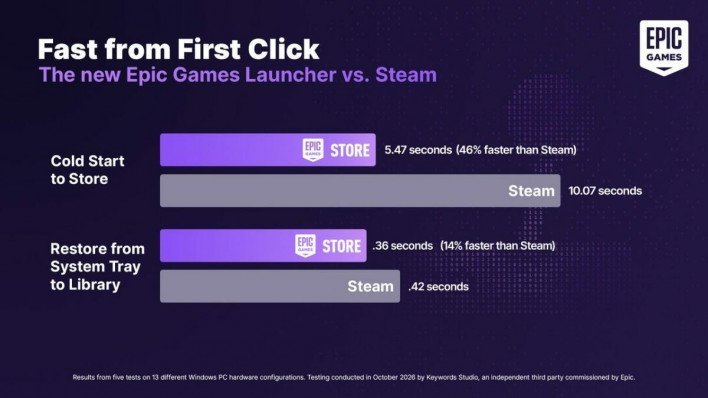
Epic's marketing push emphasized raw performance numbers. The company stated its launcher achieved a cold start time of 5.47 seconds—roughly 46% faster than Steam's measured 10.07 seconds. The launcher also restored the library from the system tray in 0.36 seconds compared to Steam's 0.42 seconds. These measurements came from testing conducted by Keywords Studios at Epic's request, averaging results from five trials across 13 different computers.

The timing proved awkward for Epic's announcement. Valve had released a Steam Client update just one day earlier, on October 13, specifically targeting startup performance. The patch notes explicitly mentioned improved Steam Client startup speed as a primary improvement, along with a fix preventing the Steam window from taking focus away from other applications upon launch.
Following Valve's update, independent testing revealed that Steam's cold start times had dropped to approximately 5 to 5.23 seconds—matching or exceeding Epic's headline figure of 5.47 seconds. One gaming outlet measured an average of 6.52 seconds across multiple Windows, Linux, and macOS systems, noting that Epic's 46% speed advantage calculation was based on Steam's performance before the October 13 update.
Direct comparison between the two sets of results remains complicated by methodological differences. Epic commissioned third-party testing from an external firm under controlled conditions, while Steam's post-update measurements came from individual user tests conducted on varied hardware and system configurations. Additionally, Epic's new launcher remains in preview stage, with the company acknowledging it as a feature-limited initial release still working toward full feature parity with the existing version.
The announcement aligns with Epic's broader strategic shift toward artificial intelligence. CEO Tim Sweeney previously disclosed on social media that the company was undergoing significant restructuring and redirecting developer resources to prioritize AI acceleration, with many operations increasingly delegated to AI tools.
Beyond startup speed improvements, Valve's October 13 update introduced several other enhancements. Big Picture mode received a new "Big Art Mode" showcasing game artwork more prominently, along with added calendar shortcuts and screensaver functionality. The update also included fixes for the Steam Input configurator, in-game overlay, Remote Play functionality, and Linux support.