The Funniest Far Side Dinosaur Comics, Ranked
 James Whitfield
3 min read
Gary Larson's Far Side comic strip became legendary for its absurdist humor and unconventional approach to cartooning during its 15-year publication run. The strip launched in 1980, appearing first in the San Francisco Chronicle, though Larson's cartooning career began earlier in 1976 with Nature's Way, initially published by Pacific Search for just $3 per comic. Larson drew inspiration from MAD Magazine and the comic strip Alley Oop, the latter potentially fueling his lifelong fascination with dinosaurs.
Far Side distinguished itself from contemporaries like Peanuts and Calvin & Hobbes through several defining characteristics. The strip maintained a strict single-panel format throughout its entire run and deliberately avoided recurring characters, instead introducing new unnamed figures in each installment. This approach allowed Larson to explore weirder, more experimental humor than mainstream comics of the era. Among the strip's most successful running themes were its dinosaur comics, which showcased Larson's talent for combining visual absurdity with clever wordplay.
One standout entry depicts a young dinosaur wearing baseball gear, gazing sadly at a series of empty caves marked "extinct." The caption reads, "Suddenly, Bobby felt very alone in the world." The comic balances physical comedy with genuine pathos—Bobby has lost all his potential playmates to extinction and faces a lonely future playing baseball solo. Another memorable strip shows three dinosaurs smoking cigarettes with angry expressions, captioned as "the real reason dinosaurs became extinct." This entry functions simultaneously as humor and public service announcement, using dinosaurs to comment on smoking's hazards.
Larson frequently employed dinosaur intelligence as comedic fodder. One strip shows dinosaurs gathered around a table for their "weekly brain-stem-storming session," a pun referencing the notoriously small brains of these creatures. The image of massive dinosaurs contorted into human-like sitting positions adds visual humor to the wordplay. Another comic depicts a dinosaur couple bidding farewell to Stegosaurus guests, with visible tears in their furniture from the creatures' prominent back spikes. The owners declare that "the Shuelers have visited us for the last time," playing on the straightforward but effective gag of incompatible houseguests.
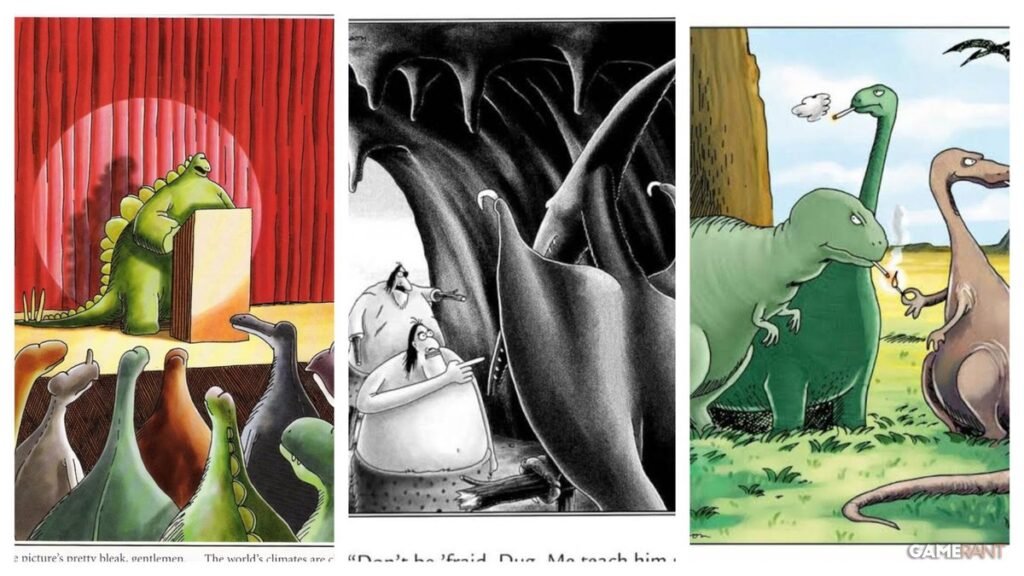
Some of Larson's most inventive dinosaur humor involved time travel and scientific inquiry. One strip features a scientist with a time machine attempting to settle the paleontological debate over whether dinosaurs were cold-blooded or warm-blooded. In his quest to take a dinosaur's body temperature directly, the scientist makes a fatal error—both he and his time machine are obliterated. The setup perfectly frames the absurdity of the punchline. Another comic shows dinosaurs at a town hall meeting discussing their bleak prospects, listing climate change, the rise of mammals, and their walnut-sized brains as contributing factors. The humor peaks when the speaker's head is drawn comically small relative to his body, visually reinforcing the joke about dinosaur intelligence.
Perhaps Larson's most enduring dinosaur contribution extends beyond humor into actual scientific terminology. One of his most celebrated strips depicts the business end of a Stegosaurus, labeled the "Thagomizer"—a term referring to the tail spikes. According to the comic, the Thagomizer received its name from "the late Thag Simmons," presumably a caveman who met an unfortunate end. The dryness of Larson's delivery, combined with the absurdity of the premise and the inherent fun of the word itself, creates a perfect comedic moment. Remarkably, paleontologists adopted this very term, and it now appears in scientific literature and discussions of Stegosaurus anatomy, making Larson's joke a permanent fixture of actual dinosaur science.
Larson's dinosaur comics also explored the awkward stages of prehistoric life. One strip shows a struggling Tyrannosaurus Rex and a Pteranodon crashing into a tall tree, with the caption explaining that "the Awkward Age was considered a hazardous time for most species." The comic draws parallels between human adolescence and prehistoric creature development. Additional entries featured pterosaurs, which Larson sometimes included despite their technical classification as pterosaurs rather than dinosaurs—a distinction most audiences overlook given their shared era and visual similarities. One such comic shows a caveman named Dug being encouraged to let a Pteranodon perch on his finger, while his friend—missing three limbs and an eye—insists it will be fine, creating dark humor through the maimed caveman's questionable judgment.
The dinosaur comics represent some of Far Side's strongest work, combining Larson's signature visual absurdity with sharp writing that rewards close reading. Whether through puns, visual gags, scientific commentary, or dark humor, these strips demonstrate why Far Side remained beloved throughout its run and continues to resonate with audiences decades later.