
External GPUs offer gaming boost but face real limits
 James Whitfield
2 min read
James Whitfield
2 min read
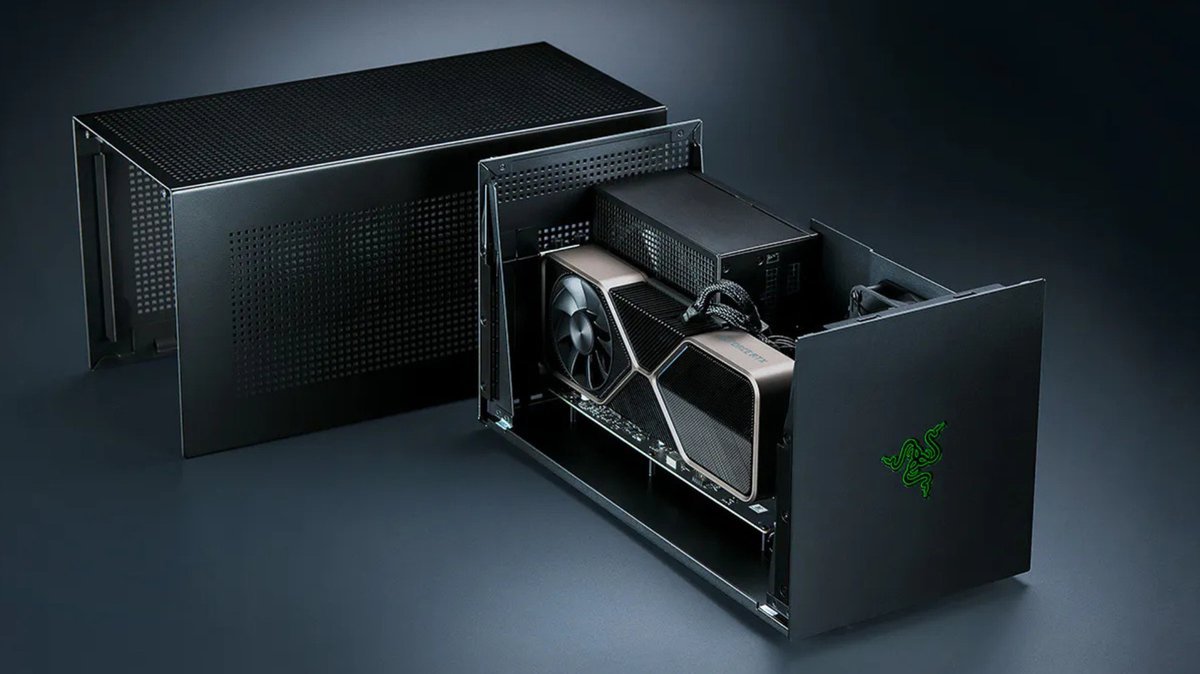
External graphics processors, or eGPUs, promise to breathe new life into aging laptops by connecting a desktop-class graphics card through Thunderbolt or USB4. While the technology does work and has improved in recent years, significant practical limitations make it a questionable investment for most gamers.
An eGPU consists of a graphics card housed in an external enclosure that connects to a compatible laptop or handheld device. The appeal is straightforward: even thin, underpowered machines can run demanding games when paired with a capable external GPU. However, the connection method itself creates a performance bottleneck. Thunderbolt 4 provides 40 gigabits per second of bandwidth, with only 32 Gbps allocated for PCIe data—roughly one-eighth of what a desktop PCIe 4.0 x16 slot offers. This limitation becomes more pronounced as graphics cards become more powerful. Testing has shown performance deficits ranging from 7 to 32 percent compared to the same card in a desktop setup, with some configurations experiencing 25 percent slowdowns at 1440p resolution. Interestingly, the faster the graphics card, the more the Thunderbolt cable restricts its performance, making mid-range GPUs a more practical choice than flagship models.
Thunderbolt 5, the newest standard with 80 Gbps of bandwidth, offers improvement but remains constrained. Razer's Core X V2 enclosure, priced at $350, still connects the GPU through PCIe 4.0 x4—providing only four lanes instead of the 16 available in a desktop. Users must also purchase a separate power supply, and Razer sells additional ports and Ethernet connectivity as a separate $390 dock. When factoring in the cost of the enclosure, power supply, dock, and the graphics card itself, the total expense rivals or exceeds that of a dedicated gaming PC, which would avoid bandwidth limitations entirely.
Compatibility presents another significant hurdle. Thunderbolt 5 laptops remain rare outside premium gaming machines and mobile workstations, meaning most users connecting an eGPU enclosure would be limited to Thunderbolt 4's 40 Gbps regardless. Apple discontinued eGPU support in 2020 when transitioning to its own silicon chips, and no subsequent macOS version has restored graphics acceleration through external GPUs. The company did approve a driver extension called TinyGPU for AI workloads, but it offers no display output, making it useless for gaming.
Alternative connection standards are emerging. Framework is developing an eGPU kit using OCuLink, which runs raw PCIe over a cable and supports up to eight lanes at 128 Gbps on the Laptop 16. This approach bypasses Thunderbolt's limitations but sacrifices convenience—OCuLink connections don't provide power to the host device and lack the simplicity of a single-cable dock solution.
Despite recent hardware improvements, including Razer's revival of its eGPU line and Framework's upcoming kit, the practical case for external graphics processors remains weak. The combination of performance penalties, substantial costs, and limited compatibility suggests that consumers seeking more gaming power would be better served by investing in a budget gaming laptop or desktop computer instead.