
Mac Studio’s Four Generations: Inside the Unchanged Aluminum
 James Whitfield
3 min read
James Whitfield
3 min read
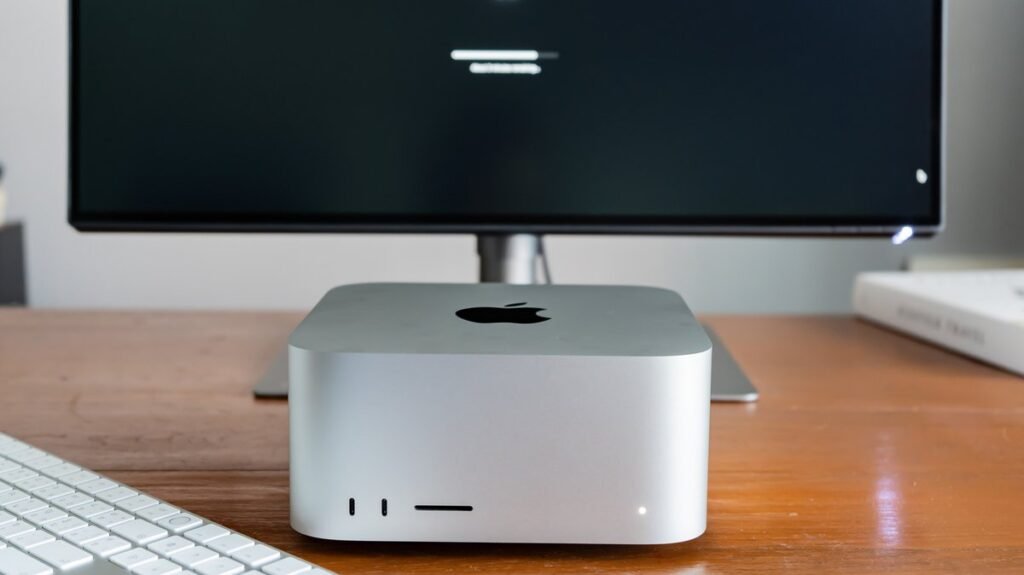
Apple's Mac Studio has maintained an identical exterior across four generations, yet the computing power packed inside its aluminum chassis has transformed fundamentally since its 2022 debut.
When the original Mac Studio launched in March 2022, it arrived as a compact alternative to the Mac Pro, featuring a distinctive 7.7-inch square aluminum body standing 3.7 inches tall. The initial lineup included Max and Ultra variants, with the M1 Max offering a 10-core CPU, 32GB of memory and a 512GB SSD starting at $1,999. The M1 Ultra, created by bonding two M1 Max chips together through Apple's proprietary UltraFusion interconnect, delivered 20 CPU cores and up to 128GB of memory for $3,999. The rear panel included four Thunderbolt ports, 10Gb Ethernet, HDMI, USB-A and USB-C ports, and an SD card slot—a configuration Apple has never modified.
The second-generation refresh arrived at WWDC in June 2023 without any exterior changes. The M2 Max jumped to a 12-core CPU with up to 38 GPU cores and 96GB of memory, while the M2 Ultra doubled those specifications to 24 CPU cores, 76 GPU cores and 192GB of memory operating at 800GB/s bandwidth. Notably, Apple simultaneously introduced the Mac Pro with the identical M2 Ultra chip but at a significantly higher $6,999 starting price, creating an unusual positioning where the smaller Mac Studio offered comparable performance at a fraction of the cost.
Apple's next update came nearly two years later in March 2025, introducing a mismatched chip strategy. The company paired the newer M4 Max with the older M3 Ultra, which featured 32 CPU cores, 80 GPU cores and up to 512GB of unified memory. This generation also brought Thunderbolt 5 connectivity at 120Gb/s. More significantly, Apple discontinued the Mac Pro entirely and announced no plans for a successor, making the Mac Studio the company's most powerful computer. However, this update coincided with an AI-driven memory shortage that forced Apple to raise prices dramatically—the M4 Max climbed from $1,999 to $2,499 and the M3 Ultra from $3,999 to $5,299, representing the steepest price increase in Mac history.
The fourth-generation Mac Studio arrived unexpectedly in August 2026, an unusual announcement timing that industry sources attributed to enterprise customer demand for machines capable of running local AI models. For the first time since 2023, both the Max and Ultra variants share the same generation of Apple silicon. The M5 Max features an 18-core CPU with 32 or 40 GPU cores and up to 128GB of memory starting at $2,499. The M5 Ultra delivers 36 CPU cores, an 80-core GPU and up to 512GB of memory from $5,499, though the highest-capacity configuration does not ship until late October.
Apple positions the M5 Ultra as delivering up to 4.3 times the AI performance compared to its M3 predecessor, along with 1.8 times greater graphics capability and 1.3 times faster CPU performance. Storage speeds have doubled, and the new generation includes Wi-Fi 7 support through Apple's custom N1 networking chip. The M5 generation also introduces a revised core architecture, replacing the traditional performance-efficiency split with "super" cores working alongside standard performance cores.
Memory bandwidth has also improved substantially across the lineup. The M5 Ultra achieves 1.2TB/s data transfer rates, nearly 50 percent faster than the M3 Ultra's capabilities. Apple notably skipped an M4 Ultra variant entirely due to hardware limitations, jumping directly from M3 to M5 for the Ultra configuration.
Despite four years of silicon evolution, the Mac Studio's unchanged industrial design remains one of Apple's most distinctive and enduring form factors. The compact footprint has proven successful enough that Apple abandoned its larger, modular Mac Pro to focus on the Studio as its flagship desktop machine for professional users.