
Red Echoes: Berlin brings political intrigue to Weimar
 James Whitfield
2 min read
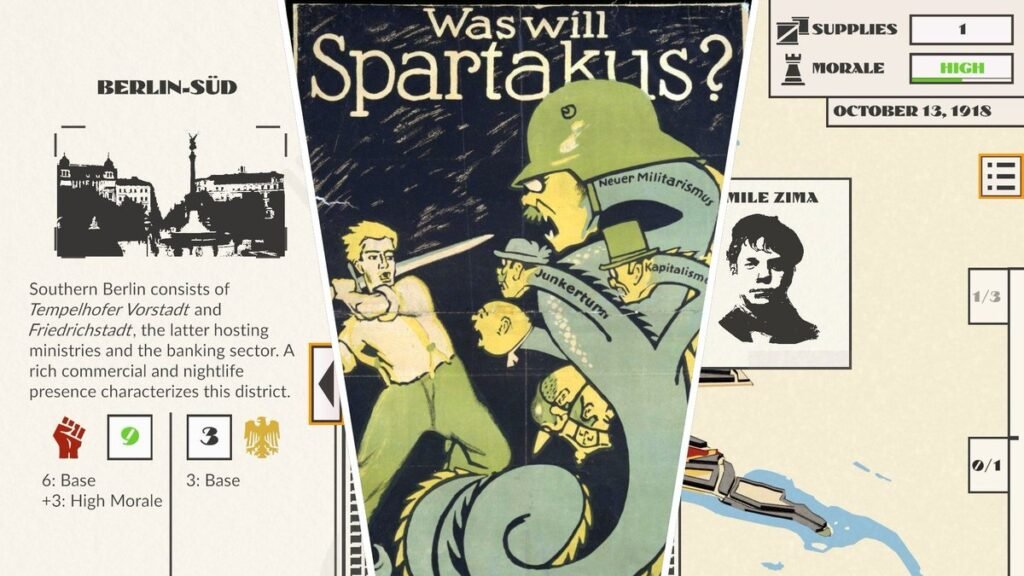

Red Echoes: Berlin, an upcoming political simulation from Morningrise Games, offers a fresh take on historical strategy by placing players in the midst of the 1919 Spartacist uprising during Germany's turbulent Weimar period. The game launches in the first quarter of next year, and a playable demo is already available for those curious about its unique approach to early 20th-century political struggle.
The game merges visual novel storytelling with board-game mechanics in a way that feels purposeful rather than gimmicky. Players control three distinct characters, each with their own special abilities tied to revolutionary and reactionary forces spreading across Berlin. One character can increase revolutionary fervor in their region, another can suppress reactionary zealotry, and a third can reduce pressure on fellow operatives. The core gameplay involves positioning these characters strategically on the map so their abilities have maximum impact when each turn concludes.
What sets Red Echoes apart from typical strategy games is its perspective. Rather than casting players as famous historical figures like Rosa Luxemburg or Karl Liebknecht, the game puts them in the shoes of ordinary Germans affected by the conflict: a dockworker, a journalist with radical sympathies, and a mother whose sons died in the Kaiser's war. This approach sidesteps the "Great Man" narrative that dominates historical media and instead offers a grounded view of how regular people experienced the end of World War One and its chaotic aftermath.
The visual novel sections drive meaningful consequences into the board state. Dialogue choices made during character interactions directly affect the game's strategic landscape—increasing or decreasing revolutionary sentiment and pressure in different districts. This creates genuine tension between ideological purity and pragmatic compromise. Players may find themselves making morally uncomfortable decisions if they believe short-term concessions will yield better long-term revolutionary outcomes, forcing players to wrestle with the gap between principles and strategy.
The demo suggests the early game leans toward accessibility. With modest planning, players can relatively easily suppress reactionary movements across most of Berlin while simultaneously spreading revolutionary sentiment elsewhere. Whether this difficulty curve remains gentle throughout the full release remains to be seen, though the demo's gentler challenge may serve as an effective onboarding for players unfamiliar with the genre.
Visually, Red Echoes employs a striking aesthetic inspired by Weimar-era graphic design, with the map gradually filling in with red pools representing revolutionary territory and yellow representing reactionary zones as turns progress. The writing quality appears solid throughout the demo, featuring believable dialogue and characters that feel authentic rather than serving as mere exposition vehicles for historical facts.
The complete game promises to run roughly three to four hours, making it a relatively compact experience. Red Echoes represents an intriguing entry into political simulation games, distinguished by its specific historical focus and willingness to center ordinary people rather than legendary figures in its narrative.




3 thoughts on “Red Echoes: Berlin brings political intrigue to Weimar”