
Complete Resident Evil Games Release Timeline
 James Whitfield
5 min read

Capcom's Resident Evil franchise has dominated the horror gaming landscape since its 1996 debut, establishing itself as one of the most influential series in the medium. With a successful recent film adaptation, multiple remakes in development, and new entries constantly in production, the franchise shows no signs of slowing down. Tracking all the releases across nearly three decades can be challenging, so here's a complete breakdown of every major Resident Evil game in chronological order.

The Original Trilogy and Early Spin-Offs (1996-2004)
The franchise launched on March 22, 1996, with the original Resident Evil, which fundamentally shaped the survival horror genre. Though it shows its age, the 2002 GameCube remake modernized the experience while preserving what made the original special, becoming a masterclass in horror design. Resident Evil 2 followed in January 1998, introducing iconic characters like Leon S. Kennedy and Ada Wong while maintaining the series' puzzle-solving and fixed camera perspective. The game remains one of the greatest horror titles ever created.
Resident Evil 3: Nemesis arrived in September 1999, introducing the relentless Nemesis creature and ramping up the action focus. Though considered slightly rushed compared to its predecessors, it cemented the franchise's reputation as a gaming trilogy for the ages. The series then experimented with spin-offs: Resident Evil Survivor (January 2000) brought light gun mechanics to the franchise, though its North American release suffered from control limitations. Code: Veronica launched on the Dreamcast in March 2000 before spreading to multiple platforms, earning recognition for its impressive visuals and cinematic presentation.
The early 2000s saw additional spin-offs including Resident Evil Survivor 2: Code: Veronica (November 2001), another light gun shooter that received limited North American distribution, and Resident Evil Gaiden (December 2001), an exclusive Game Boy Color title featuring top-down perspective and first-person combat sequences. These entries represented early attempts to expand the franchise beyond traditional survival horror.
Expanding the Formula (2002-2009)
Resident Evil Zero launched on GameCube in November 2002, introducing the "partner zapping" system that allowed players to control two characters simultaneously. The game proved divisive—some praised its visual improvements and atmospheric enhancements, while others felt disappointed by the lack of sweeping gameplay changes. Dead Aim (February 2003) offered another light gun experience that, unlike its predecessors, actually received a North American release and introduced the ability to move while aiming.
Resident Evil Outbreak (December 2003) marked a significant milestone as the franchise's first cooperative and online multiplayer entry. With eight playable characters and five scenarios featuring different objectives, it fulfilled longtime fan requests to experience the horror with friends. Its sequel, Outbreak: File #2 (September 2004), improved upon the original with enhanced mechanics including the ability to move while firing and gather items while crawling.
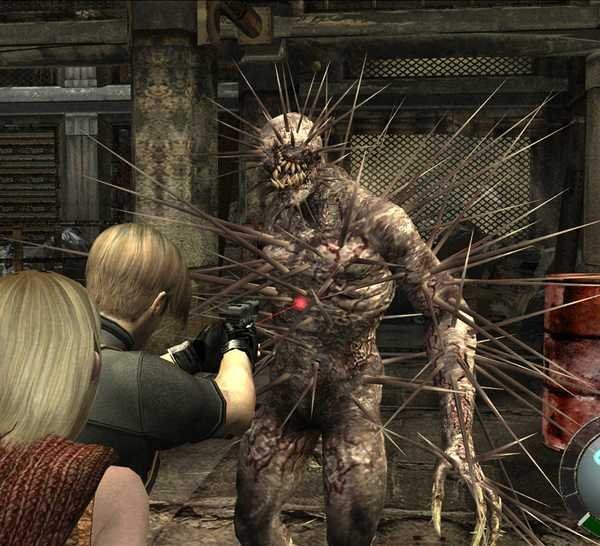
Resident Evil 4 arrived on January 11, 2005, and became a watershed moment for the series. Featuring a full third-person perspective, enhanced shooting mechanics, and a more action-focused approach, it transformed the franchise while maintaining quality storytelling. The game's influence on third-person action games cannot be overstated. A Nintendo DS adaptation, Resident Evil: Deadly Silence (January 2006), brought the original game to handheld systems with stylus-based combat and new puzzle variations.
The Wii received two on-rails shooters: The Umbrella Chronicles (November 2007) and The Darkside Chronicles (November 2009), both utilizing motion controls to create immersive shooting experiences. Resident Evil 5 (March 2009) launched nearly five years after RE4, attempting to push the franchise further into action territory with cooperative gameplay and new locations. While initially disappointing some fans expecting more dramatic evolution, it eventually gained recognition as a solid action shooter.
The Handheld and Multiplayer Era (2011-2016)
Resident Evil: The Mercenaries 3D (June 2011) expanded the popular minigame from RE4 into a full experience on Nintendo 3DS, focusing on time-limited point accumulation and customizable loadouts. Resident Evil: Revelations (January 2012) originally launched exclusively on 3DS before porting to modern consoles, positioning itself between RE4 and RE5 chronologically while maintaining action-heavy combat with an over-the-shoulder perspective.
Resident Evil: Operation Raccoon City (March 2012) attempted to blend single-player campaigns with four-player cooperative and competitive multiplayer modes, but suffered from lackluster gameplay and mechanical issues that undermined its ambitious scope. Resident Evil 6 (October 2012) continued the franchise's controversial shift toward action, featuring four campaigns with seven playable characters and introducing new evasion mechanics. Though divisive among longtime fans, it offered substantial content and multiplayer options.
Resident Evil: Revelations 2 (February 2015) returned to the subseries with episodic releases, emphasizing stealth and ammunition management alongside cooperative gameplay. The Raid Mode minigame returned with a new narrative featuring an AI character. Umbrella Corps (June 2016) represented a low point, attempting a competitive multiplayer shooter that failed to impress critics and players alike, eventually becoming disassociated from the main franchise branding.
Modern Renaissance (2017-2023)
Resident Evil 7: Biohazard (January 2017) fundamentally reinvented the series by shifting to first-person perspective and introducing a new protagonist, Ethan Winters. The game successfully restored horror as the franchise's core focus, trapping players in a deranged family's compound. This reset allowed new and returning players to engage without extensive series knowledge, making it the franchise's scariest entry.
The remake cycle accelerated with Resident Evil 2 (January 2019), which arrived nearly two decades after the original's 2002 remake. The 2019 version overhauled the combat system with an over-the-shoulder perspective, earning widespread critical acclaim and a Golden Joystick Award for Ultimate Game of the Year. Resident Evil 3 (April 2020) followed quickly but received mixed reception due to its shorter runtime and controversial Nemesis implementation, though retrospective appreciation has grown.
Resident Evil: Resistance launched alongside RE3 as a bundled multiplayer title featuring four players against one "mastermind" controller. The asymmetrical concept showed promise but struggled to maintain a player base due to balance issues. Resident Evil Village (May 2021) continued Ethan's story with a blend of action and horror elements, offering a substantial single-player campaign in an era increasingly dominated by multiplayer-focused titles.
Resident Evil Re:Verse (October 2022) attempted an arena shooter format but suffered from balance problems, aggressive monetization, and tepid gameplay, leading Capcom to shut down servers in 2025. The franchise's most celebrated remake arrived with Resident Evil 4 (March 2023), which silenced skeptics by successfully modernizing the original while maintaining its essence, proving that even beloved classics could benefit from thoughtful reimagining.
Recent and Upcoming Releases
Resident Evil Requiem launched on February 27, 2026, as the franchise's most recent entry. The game distinguishes itself by incorporating both first- and third-person perspectives that players can switch between dynamically, allowing horror-focused sequences in first-person and action-oriented segments in third-person. It successfully balances both genres while advancing the series' narrative.
Capcom revealed Resident Evil Survival Unit in July 2025 as the franchise's first mobile game since 2013. The Android title takes an unusual direction with base-building and player-versus-player mechanics, receiving mixed reception from players. Looking ahead, Resident Evil Veronica is scheduled for 2027, finally delivering the long-requested remake of the 2000 Code: Veronica. The remake will feature story modifications to fit the current timeline, prominent roles for Chris Redfield and Albert Wesker, and gameplay similar to the RE2 and RE3 remakes, with leaks suggesting dismemberment, horde mechanics, and dual wielding.
From the original PlayStation mansion to the modern era's perspective-shifting gameplay, Resident Evil has continuously evolved while maintaining its core identity. Whether players prefer the survival horror roots or the action-forward modern entries, the franchise offers something for nearly every taste across its expansive library of releases.