
Musk Confirms Surplus GPUs Sitting Idle in Unfinished Data
 James Whitfield
2 min read
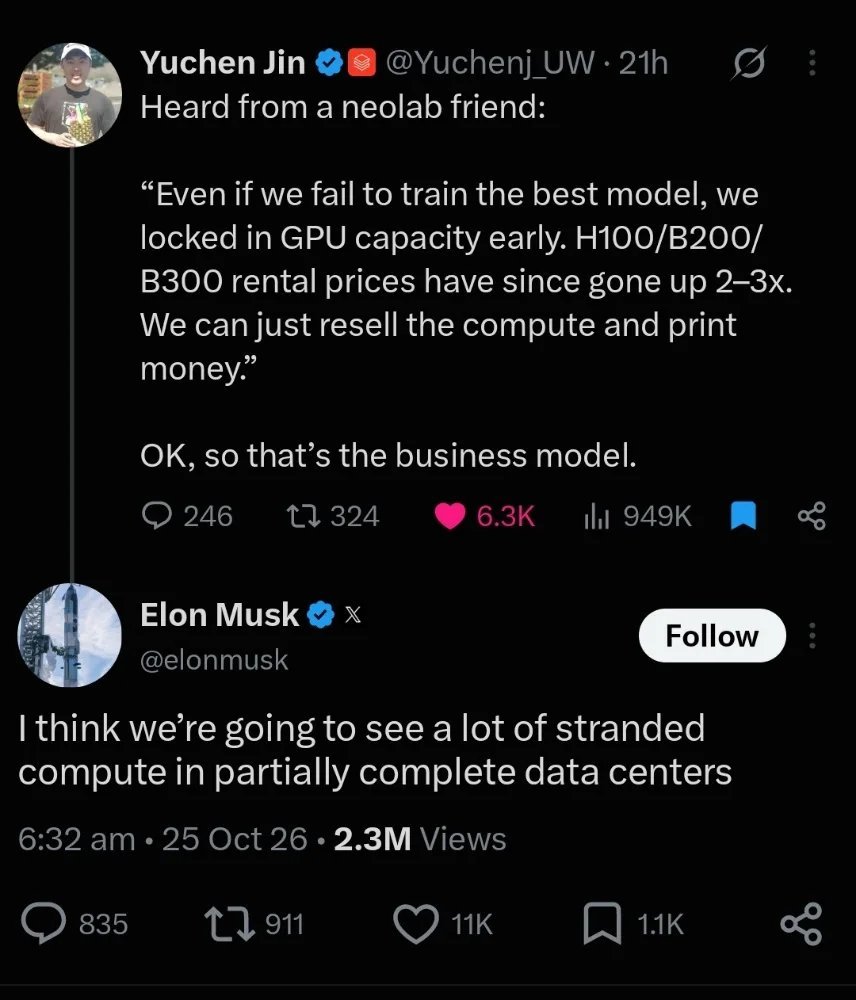
Elon Musk has publicly confirmed growing concerns about massive quantities of graphics processors sitting unused in partially constructed data centers across the industry. In a social media post, Musk acknowledged what technology analysts and media outlets have documented in recent weeks: substantial GPU inventory is accumulating in warehouses with little prospect of deployment due to fundamental market misalignments.
Musk's comments came while responding to a technology researcher who noted that artificial intelligence startups are securing early allocations of high-end Nvidia chips—including the H100, B200, and B300 models—primarily to resell the computing capacity at a profit rather than deploy it themselves. This resale strategy suggests many companies view hardware acquisition as a speculative investment rather than a tool for genuine operational needs.
The situation reflects a widening gap between the volume of enterprise hardware purchases and actual real-world applications. Major cloud providers including Amazon Web Services, Microsoft, and Meta faced pressure to accept early delivery of expensive server equipment to maintain priority access to future chip shipments. This competitive dynamic has left these companies holding substantial computing resources that cannot be immediately deployed, creating what the industry calls "stranded compute."
The hardware accumulation has had significant ripple effects across consumer markets. Nvidia's aggressive sales strategy to enterprise customers, driven partly by corporate fear of missing out on AI opportunities, has redirected semiconductor manufacturing capacity away from consumer graphics cards. This reallocation has triggered sharp price increases in PC gaming GPUs and related consumer electronics, including memory and storage components. Further price increases are anticipated across multiple consumer electronics categories as the supply imbalance persists.
However, the underlying issue extends beyond supply chain disruption. Recent economic analysis reveals that despite massive spending on AI infrastructure, industries outside the technology sector have seen minimal productivity gains. A comprehensive report examining twelve major economic sectors found zero measurable improvements in productivity even after billions in AI investment. Healthcare, retail, and manufacturing sectors showed flat or declining productivity metrics. While some technology companies report efficiency improvements, these gains fall far short of justifying the scale of capital expenditure, leaving an estimated $4.9 trillion revenue gap in the AI industry.
The fundamental problem is that data center construction has proceeded based on speculative demand assumptions rather than demonstrated market need. Nvidia reallocated the majority of its manufacturing capacity from consumer applications to enterprise customers based on projections of rapid adoption and unprecedented returns on investment. This reallocation created artificial scarcity in the consumer market, particularly for gaming hardware, while simultaneously leaving enterprise customers with underutilized equipment.
Industry observers expect the gaming market supply situation to gradually normalize as semiconductor production capacity expands and enterprise data center spending growth slows. However, the artificial shortage in consumer GPU availability could persist for years as the market works through the consequences of Nvidia's capacity reallocation decisions and the broader mismatch between speculative enterprise hardware purchases and actual deployment capabilities.