
Asian Games Gold Medals Show Quality Defects Beyond Official
 James Whitfield
2 min read
James Whitfield
2 min read
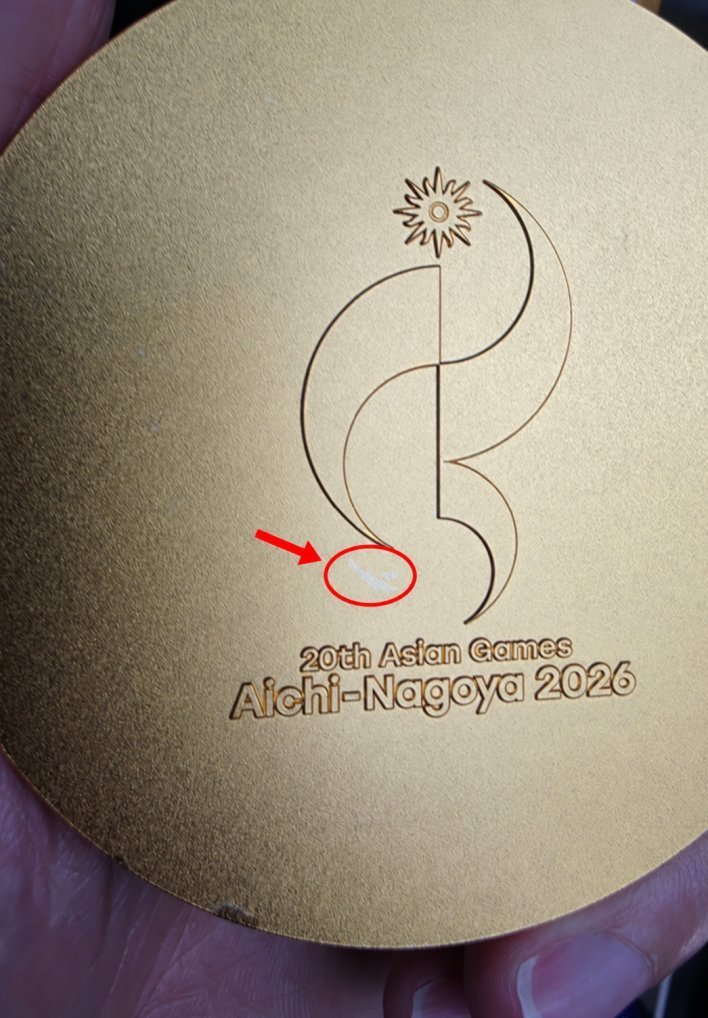

Quality issues have emerged with gold medals distributed at the 2026 Aichi-Nagoya Asian Games, with South Korean esports competitors reporting surface defects that extend beyond the single replacement case the organizing committee acknowledged.
The organizing committee initially reported that only one medal had been exchanged due to defects after an athlete noticed discoloration along the medal's edge and requested a replacement. The committee arranged for staff to deliver a new medal to the athlete's accommodation that same evening. As of late in the month, organizers maintained this was an isolated incident, a claim that drew praise from Japanese sports media for the Japan Mint's craftsmanship and quality control, given that approximately 7,000 medals were being used throughout the games.
However, an investigation uncovered evidence contradicting this narrative. Photographs obtained from a South Korean esports gold medalist revealed an irregular white mark positioned between the tournament emblem and the English event title, visibly contrasting with the surrounding gold surface. When interviewed, the athlete described additional damage on the reverse side that resembled white paint flaking away. Crucially, the athlete reported that similar marks appeared on all gold medals received by teammates who won alongside them in the same event.
After the athlete reported these findings to the Korea e-Sports Association, the organization requested detailed photographic documentation of the medal's condition. The KeSPA subsequently contacted the Asian Games Organizing Committee through the Korean Sport & Olympic Committee to inquire about replacement procedures and is currently awaiting a response.
The discrepancy between the committee's public statement and the documented evidence raises questions about the thoroughness of quality assessment. The single replacement case cited by organizers resulted from an athlete directly raising concerns and requesting an exchange, rather than from a comprehensive inspection of all medals already distributed. This distinction suggests that the true extent of defects may not have been systematically evaluated.
While the exact cause of the white marks on the South Korean medals remains unconfirmed, the fact that these abnormalities appeared on medals that had passed dual inspections by both the manufacturer and the organizing committee indicates a potential quality control failure. Officials have not issued a formal defect ruling, but the evidence suggests a need for a comprehensive examination of all awarded medals rather than handling replacements on a case-by-case basis.
The medal quality issues compound existing controversies surrounding the 2026 games. Since the event's opening, organizers have faced criticism over meal service, accommodation problems, and athlete transportation logistics. The discovery of defects on medals that were initially presented as virtually flawless adds to the perception of inadequate preparation and management across multiple aspects of the games.