
iPhone Duo vs Galaxy Z Fold 8: Full comparison
 James Whitfield
4 min read
James Whitfield
4 min read
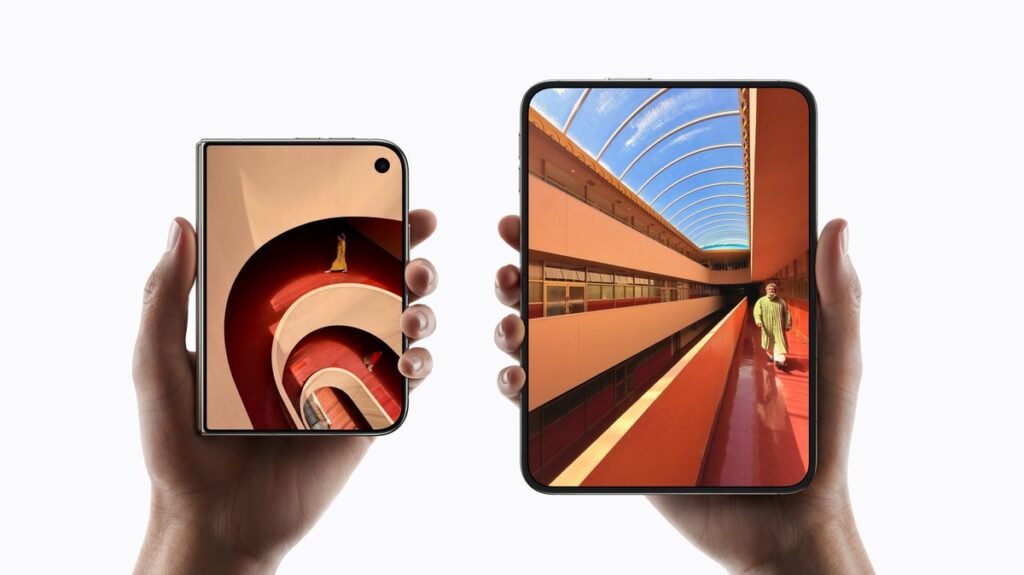
Apple has entered the foldable smartphone market with the iPhone Duo, its first device with a bendable screen, positioning it as a direct competitor to Samsung's Galaxy Z Fold 8. Both phones adopt the same compact, passport-style form factor that unfolds into a nearly square display, marking a significant shift in how Apple approaches smartphone design.
Samsung launched the Galaxy Z Fold 8 in August, departing from the traditional tall, narrow design of previous generations. The company reported strong early sales, with the Z Fold 8 and its larger sibling, the Z Fold 8 Ultra, outselling last year's model by 30 percent in their first month. Apple's entry into the category is expected to generate substantial market interest, given the company's track record with new device categories.
Display and Screen Technology
Both devices feature 7.6-inch inner displays that unfold to reveal the main screen. The Z Fold 8 offers a resolution of 2,448 by 1,848 pixels, while the iPhone Duo delivers 1,878 by 2,670 pixels—slightly sharper despite the same physical size. Both screens refresh at 120Hz. The outer displays measure 5.5 inches on the Samsung and 5.4 inches on the Apple device, with the iPhone again claiming a marginal resolution advantage.
Samsung manufactures the folding OLED screens for both phones and equipped both with anti-reflective coatings that reduce glare in bright sunlight. Apple calls its version a "nano-texture finish," but it serves the same purpose. Apple claims its inner screen has 40 percent greater stiffness than competing materials. Both devices use a titanium plate underneath the folding layers for additional reinforcement.
Processing Power and Performance
The Galaxy Z Fold 8 runs on Qualcomm's Snapdragon 8 Elite Gen 5, built on a 3-nanometer process. The iPhone Duo uses Apple's A20 Pro chip, manufactured on a smaller 2-nanometer process. While the Snapdragon competed well against Apple's previous A19 Pro generation, the A20 Pro pulls ahead in both productivity and gaming performance. Apple reports the A20 Pro delivers 50 percent more memory bandwidth and a 40 percent faster graphics processor compared to its predecessor. Samsung's Galaxy includes 12GB of RAM in standard configurations, jumping to 16GB in the top-tier 1TB storage model. Apple has not disclosed the iPhone Duo's RAM specifications, though the company's reputation for software optimization typically means iOS manages memory more aggressively than Samsung's Android implementation.
Camera Capabilities
Neither manufacturer equipped these foldables with the camera systems found in their flagship slab-style phones, and both notably omit telephoto lenses—a significant limitation for users who rely on zoom photography. The Z Fold 8 features dual 50-megapixel cameras on the back, covering wide and ultrawide perspectives. The iPhone Duo uses 48-megapixel sensors for both wide and ultrawide shooting.
Front-facing cameras differ more substantially. Samsung's Fold 8 includes two 10-megapixel selfie cameras: a 24mm wide lens on the cover screen and an 18mm ultrawide on the inner display. Apple equipped the iPhone Duo with a 12-megapixel cover camera and an under-display camera on the inner screen, though specifications for the latter remain undisclosed and appear optimized primarily for video calls.
Battery Life and Biometrics
The Z Fold 8 houses a 4,800 mAh battery supporting 45W wired charging and 20W wireless charging. The iPhone Duo's battery capacity remains unannounced, though Apple specifies 31 hours of video playback on the inner display and 44 hours on the outer screen, with 25W MagSafe charging.
Both devices abandon their manufacturers' traditional biometric approaches due to form factor constraints. The iPhone Duo brings back a fingerprint sensor integrated into the power button—a feature Apple abandoned years ago—while the Galaxy Z Fold 8 uses the same solution rather than Samsung's typical under-display ultrasonic sensor. The practical performance of each implementation will require hands-on testing to determine.
Multitasking and Software
Apple has designed multitasking features for the iPhone Duo that allow running two apps side-by-side with resizable layouts and the ability to save app pairs for quick access. Samsung's One UI, refined across multiple foldable generations, offers considerably more sophisticated capabilities. The Galaxy Z Fold 8 can run three apps simultaneously in windowed mode, with support for up to five total apps open at once. Samsung's implementation allows dragging files between applications, collapsing apps into bubbles for quick access, and even connecting to external monitors for a desktop-like experience with full keyboard and mouse support.
Durability and Price
Durability remains a concern with foldable devices. The Galaxy Z Fold 8 carries an IP48 rating, protecting against rain but not submersion or beach environments. The iPhone Duo achieves IP68 protection combined with a titanium construction, offering superior durability on paper.
Pricing heavily favors Samsung. The iPhone Duo starts at $1,999 for 256GB storage and reaches $3,199 for the 2TB model. The Galaxy Z Fold 8 begins at $1,900 for 256GB and caps at $2,500 for the 1TB variant with extra RAM. The price difference becomes more pronounced at higher storage tiers, where Apple's configuration costs significantly more.
The Bottom Line
The iPhone Duo demonstrates clear advantages in processing performance, durability, and overall build quality. However, these benefits come at a premium price. Samsung's Galaxy Z Fold 8 offers a more affordable entry point and substantially more advanced multitasking capabilities for users who demand productivity features. The choice ultimately depends on priorities: those seeking raw performance and durability may prefer the iPhone, while power users requiring sophisticated multitasking and a lower price point should consider Samsung's offering.